

This page was originally constructed in 2000 - early days for the internet. I updated some links and images in 2010 and 2015, but have left much of the original text as a 'souvenir'! References may be outdated and obsolete links may be re-directed to stored information.
Microcitrus australasica or Citrus australasica
My Search through the Australian Rainforest
After working in Sydney for the summer Olympic Games in the year 2000, I had a fortnight being a tourist. So I set aside a couple of days to see if I could find and photograph the Australian Fingerlime growing in its native habitat.
I used the Internet to find any specific references to where these plants are growing.
I found three sites that could be included in my itinerary. All within a couple of hours drive of each other, about 150km south of Brisbane.
1. Tyalgum Sports Ground, in a village on the northern border of New South Wales, west of Murwillumbah. See
http://www.tweed.nsw.gov.au/Community/pdfs/RareAndSignificantTrees.pdf
2. Southern Cross University Medicinal Garden, Lismore, New South Wales. See http://www.scu.edu.au/schools/ncm/garden/comname.html
3. Lamington National Park, on the southern border of Queensland. See
http://lamington.nrsm.uq.edu.au/mainmenu.html
I also hoped to visit the Bangalow, NSW, nursery of Erika Birmingham, an expert on Australian native citrus, but this did not prove possible. However, I did telephone her and she suggested looking in a patch of remnant rainforest in Lismore called Rotary Park.
http://www.visitlismore.com.au/content/uploads/Lismore_Rotary_Park_Rainforest_Walk7162010121616.pdf
I found three sites that could be included in my itinerary. All within a couple of hours drive of each other, about 150km south of Brisbane.
1. Tyalgum Sports Ground, in a village on the northern border of New South Wales, west of Murwillumbah. See
http://www.tweed.nsw.gov.au/Community/pdfs/RareAndSignificantTrees.pdf
2. Southern Cross University Medicinal Garden, Lismore, New South Wales. See http://www.scu.edu.au/schools/ncm/garden/comname.html
3. Lamington National Park, on the southern border of Queensland. See
http://lamington.nrsm.uq.edu.au/mainmenu.html
I also hoped to visit the Bangalow, NSW, nursery of Erika Birmingham, an expert on Australian native citrus, but this did not prove possible. However, I did telephone her and she suggested looking in a patch of remnant rainforest in Lismore called Rotary Park.
http://www.visitlismore.com.au/content/uploads/Lismore_Rotary_Park_Rainforest_Walk7162010121616.pdf
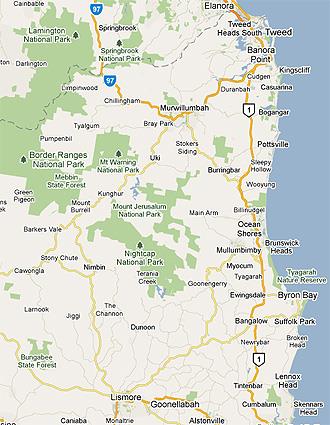
From GoogleMaps, this area of northern New South Wales is the centre of the natural range of the Fingerlime
Tyalgum Sports Ground.
Well, I eventually found Tyalgum, an attractive one-shop village on the way to nowhere.
And, just opposite the store was the Sports Ground, with a few trees and shrubs around it and the neighbouring properties.
So, I spent an hour or so poking my nose into these areas, but without success. No Fingerlime that I could see anywhere.
A failure - I gave up and moved on!
(If any resident of Tyalgum ever reads this, perhaps they can tell me where I went wrong!
Well, I eventually found Tyalgum, an attractive one-shop village on the way to nowhere.
And, just opposite the store was the Sports Ground, with a few trees and shrubs around it and the neighbouring properties.
So, I spent an hour or so poking my nose into these areas, but without success. No Fingerlime that I could see anywhere.
A failure - I gave up and moved on!
(If any resident of Tyalgum ever reads this, perhaps they can tell me where I went wrong!
Southern Cross University, Lismore.
After losing my way a few times, I eventually found the Medicinal Garden on the landscaped University campus grounds.
There were formal herbal plant beds, plus shrub borders and more shrubs and trees in the vicinity.
After losing my way a few times, I eventually found the Medicinal Garden on the landscaped University campus grounds.
There were formal herbal plant beds, plus shrub borders and more shrubs and trees in the vicinity.
Again, I poked around the shrubs and investigated the area but without success. No Fingerlime that I could see anywhere.
A failure - I gave up and moved on!
(If anyone from Southern Cross University ever reads this, perhaps they can tell me where I went wrong!)
A failure - I gave up and moved on!
(If anyone from Southern Cross University ever reads this, perhaps they can tell me where I went wrong!)

Lismore Rotary Park.
On the outskirts of the town of Lismore, this proved to be an area of rainforest, a few kilometres across with a single walking track running through it. The rainforest had been restored and allowed to re-establish a few years ago after having been cleared of invading 'exotic' (ie. non-native) plant species.
On the outskirts of the town of Lismore, this proved to be an area of rainforest, a few kilometres across with a single walking track running through it. The rainforest had been restored and allowed to re-establish a few years ago after having been cleared of invading 'exotic' (ie. non-native) plant species.

Now, looking for a small-leaved plant in a rainforest proved difficult. First of all, even on a sunny day, very little light reaches the forest floor and it's really quite gloomy. Secondly, the dappled bright sunlight that does reach the ground seems to confuse the vision. Thirdly, staring up into the surrounding vegetation definitely results in a loss of concentration on keeping one's footing - its too easy to trip over. Finally, after a very dry period the amount of loose debris and leaf litter around added to the problems.
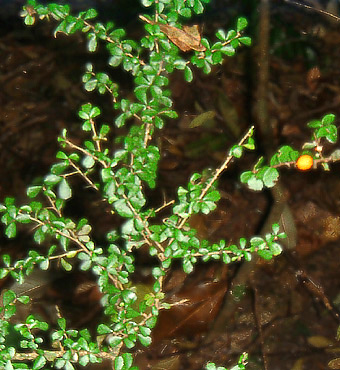
Citriobatus pauciflorus = Pittosporum multiflorum
Several times I found a likely looking small-leaved thorny shrub, but closer inspection proved this to be a different species, later identified as Citriobatus pauciflorus, or Orange Thorn, with leaves somewhat like a Cotoneaster.
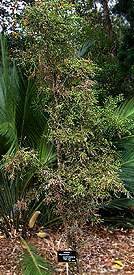
Finally, however, success! I discovered first one, then several other Fingerlime plants, Microcitrus Australasica. They proved to be spindly, single-stemmed shrubs up to about 4metres tall, with a clump of growth at the top. I managed to bend over one of the tallest, and found a few flowerbuds just forming in this top growth. There were also several seedlings in the vicinity, about a metre high. I had a good look on the ground to see if I could find any remnants of last seasons fruit, but, unsurprisingly, there was nothing to be found.
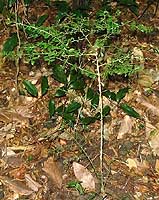


Seedling, about 1m tall
Clump of side growth from taller plant, with main stem on left
Close-up of leaves
Click on photos for higher definition
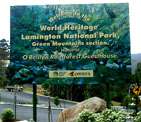


O'Reilly's Rainforest Guesthouse is a well-known environmental and walking centre in Lamington National Park, a World Heritage site in Queensland and the New South Wales border area.
In the guesthouse library were several volumes of dried samples of local flora.
The page for Fingerlime, dated 1979, said the specimen was found on Luke's Bluff Road.
I located this road, and after some time investigating the edge of the rainforest, success again - I found several Fingerlime plants
The page for Fingerlime, dated 1979, said the specimen was found on Luke's Bluff Road.
I located this road, and after some time investigating the edge of the rainforest, success again - I found several Fingerlime plants
I removed a small twig to take back and compare with the 1979 sample.
This was my last stop before leaving Australia, and there was a Microcitrus australasica right by the car-park.
Although this plant carried much more growth all along the stem compared to the rainforest plants, it had a lot of dieback and dead areas. Clearly not completely happy in this unshaded, lowland situation
Although this plant carried much more growth all along the stem compared to the rainforest plants, it had a lot of dieback and dead areas. Clearly not completely happy in this unshaded, lowland situation

